The Nova Scotia Association of REALTORS® celebrates 25 years
Years before any organization was dedicated to real estate practice in Nova Scotia, the market was largely unregulated. Advertisements for properties in the province were found in local newspapers like the Chronicle Herald or The British Colonist. Brief notices would direct you to one of the province’s few practitioners of property trading.
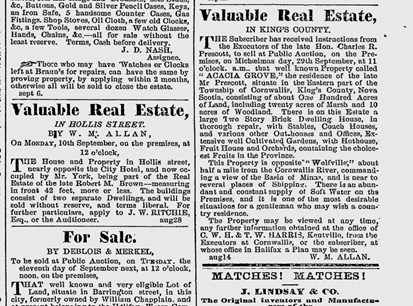
(Photo: The British Colonist – September 8, 1860.)
It is challenging to pinpoint exactly when Nova Scotia’s various real estate Boards were founded, however records show that the Halifax-Dartmouth Real Estate Board (HDREB) goes back to at least 1943. Other local Boards developed across the province over the following 50 years. HDREB and other local real estate boards merged in 2000 to form the Nova Scotia Association of REALTORS® (NSAR)
Since its founding in 2000, NSAR has grown to over 2,100 members who subscribe to a high standard of service and a strict code of ethics.
Technology’s impact on real estate
In the last 25 years, members have seen tremendous changes in the industry, mostly due to technology's impact.
In 2003, NSAR launched its first online Multiple Listing Service® System (MLS®), the first time anyone in Nova Scotia doing listing input could upload their photos to listings. That same year, NSAR started regularly distributing MLS® statistics to the media, making NSAR and its members the primary source for Nova Scotia housing information.
Reflecting on NSAR's evolution, Mary MacDonald, NSAR's first President, found that since her Presidency, "Technology has been one of the biggest changes to occur, from having to hire persons to take photos of the properties to now being able to do them ourselves and using equipment such as drones.”
The Association, through an agreement with the Nova Scotia Real Estate Commission, provides all real estate licensing courses in the province. In 2024,NSAR launched a new, more robust, and longer Salesperson Licensing course that aims to better prepare new salespeople for the realities of the industry. The course is available online and in person. The Association also offers annual mandatory courses and the Broker Licensing Course.Real estate education and support
NSAR provides resources, tools and services to support member business success. CEO, Roger Boutilier says, “Constantly looking ahead and being aware of the latest technologies helps our members stay at the forefront of the industry. This is a key priority for NSAR. With the pace of new technologies being introduced, this can be challenging. Our industry must continue to evolve to offer the best service possible to clients who are also doing their homework and staying tech-savvy.” The Association currently offers tools and services such as Paragon, Paragon Connect, WEBForms®, CRS Data, ShowingTime, ZipForms, Dotloop, Market Stats, Property Online, Restb.ai, Cloud CMA, Bridge Interactive, Home Pricing Index, SUPRA lockboxes (Halifax-Dartmouth only) and Offer Manager, plus one-on-one and brokerage training services and resources.
The Association has over 90 member volunteers on various committees who help carry out the work of NSAR on behalf of members. This includes a Board of Directors who sets policy and direction and a staff of 16. The Association conducts annual member surveys to understand what is top of mind for members, and the CEO and Board Executive meet with members annually.
Advocating for attainable housing
NSAR has made remarkable progress over the past 25 years, becoming a leading force in Nova Scotia's real estate industry. NSAR is the voice of housing in Nova Scotia, with a strong advocacy program focused on increasing housing attainability for all Nova Scotians. NSAR’s Political Action Committee (PAC) is a multiple award-winning team that works with the Canadian Real Estate Association(CREA) to advocate for programs to strengthen homeownership for Canadians. Closer to home, NSAR’s Provincial/Municipal Action Committee (PMAC) works with municipal and provincial levels of government to improve attainable housing for Nova Scotians.
NSAR CEO, Roger Boutilier says, “Prior to the fall provincial election, we surveyed members on the issues that were top of mind to them. Deed Transfer Tax reforms, innovative housing ideas, housing affordability, and disbursement of municipal lands were at the forefront, and formed the advocacy plan for that. These issues were similar to NSAR’s plan in the municipal elections earlier in the fall. Overall, NSAR’s ‘asks’ were evident in the various candidate and party platforms. NSAR members feel passionate about opening up homeownership in all areas of the housing spectrum- from low-income housing to moderate and beyond. Our members care about their communities.”
2025 proves to be another busy year for the association on the advocacy front. In January, NSAR will host the Nova Scotia Cross-Sector Housing Summit, a collaborative effort by the Nova Scotia Non-Profit Housing Association, Pivot Housing Solutions, and NSAR. This summit will bring professionals across the private, social, and non-profit housing sectors together to tackle pressing housing issues and identify actionable solutions.
Economic and societal impact of real estate
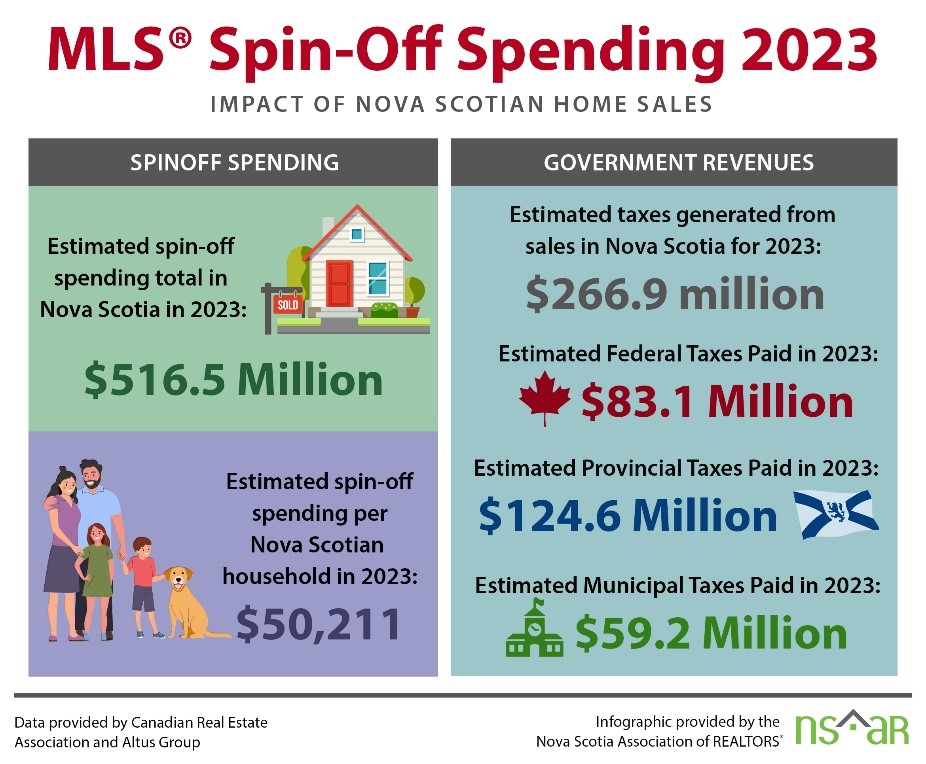
The real estate industry is a key contributor to the Nova Scotian economy. Spin-off spending related to home sales in Nova Scotia was $516.5 million in 2023, approximately 1.3% of the Province's Gross Domestic Product (GDP).
REALTORS® are continuously looking at new and better ways to serve their clients. With this in mind, in 2024 NSAR added several new measurement fields to the MLS® System. The new information being captured about homes in Nova Scotia includes door and hallway widths, bathroom dimensions, turning radius of kitchen and bathrooms, types of entries into the property, and the ability to note any special features of the home. This increased information will help potential homebuyers determine the accessibility and adaptability of a home and if it meets their mobility needs.
NSAR is the first MLS® System in the country to make these measurement fields mandatory in June 2024. Director of NSAR’s MLS®, Bonnie Wigg says, "We identified the most common barriers people with mobility issues face in the built environment and worked with several key partners to look at how we could make a difference in searching for an accessible or adaptable home. Everyone’s definition of an accessible home is different, so adding more information to listings enables people to determine if a home is right for them.”
Current market
With the market moving into more balanced territory, and lower priced listings being harder to come by, the market looks very different in 2024 and 2025 than it did during the height of the COVID-19 pandemic.
Past President Matthew Dauphinee says, “Currently, in Nova Scotia, the market can be divided into price points, and what may be true for one price point is not the same for another. Sellers and Buyers at different price points have very different experiences. Below $500k has more buyers, the Down Payment Assistance Program has helped that end of the market, where the $800k+ market has fewer buyers, or may see more homes selling subject to the sale of the buyers’ home.”
Dauphinee says, “External factors such as scrutiny on the financial side, higher property taxes than we saw before 2022, and increased insurance costs have buyers considering much more than their mortgage payment. Homes priced at the lower end of the market are fewer, which challenges the affordability of homes.”
Market Forecast
While there is no crystal ball, Dauphinee says, “We expect a steady market, similar to 2024, with a slight increase as some buyers, will return to the table for lower interest rates and predictions of increased new construction. Consumer confidence is definitely on the rise.”
Looking toward spring, President Andrew Gilroy believes that “Mortgages that were taken out during the COVID years will be coming up for renewal. This will force some to sell, creating a spike in inventory. If rates settle by early spring, we will see a surge in activity. Buyers are waiting for the lowest possible point on the interest rates to jump back into the market.”
What’s next
NSAR will continue to stay ahead of technological developments to offer members the most useful tools to support their success as agents. This includes using AI to expedite listing input and compliance and digital tools to support real estate transactions. Member education, experience, and engagement are also priorities for the Association, so members have the latest information and skills to stay competitive.
Find out more about NSAR at NSRealtors.ca.

Mary MacDonald, NSAR’s first President

Andrew Gilroy, NSAR’s Current President

NSAR CEO, Roger Boutilier
Contact: Tanya White, Communications Director
NSAR
[email protected]
(902) 468-2515